

Q&A with Baylor’s New Program Directors for Entry-level and Post-professional Doctor of Occupational Therapy Programs
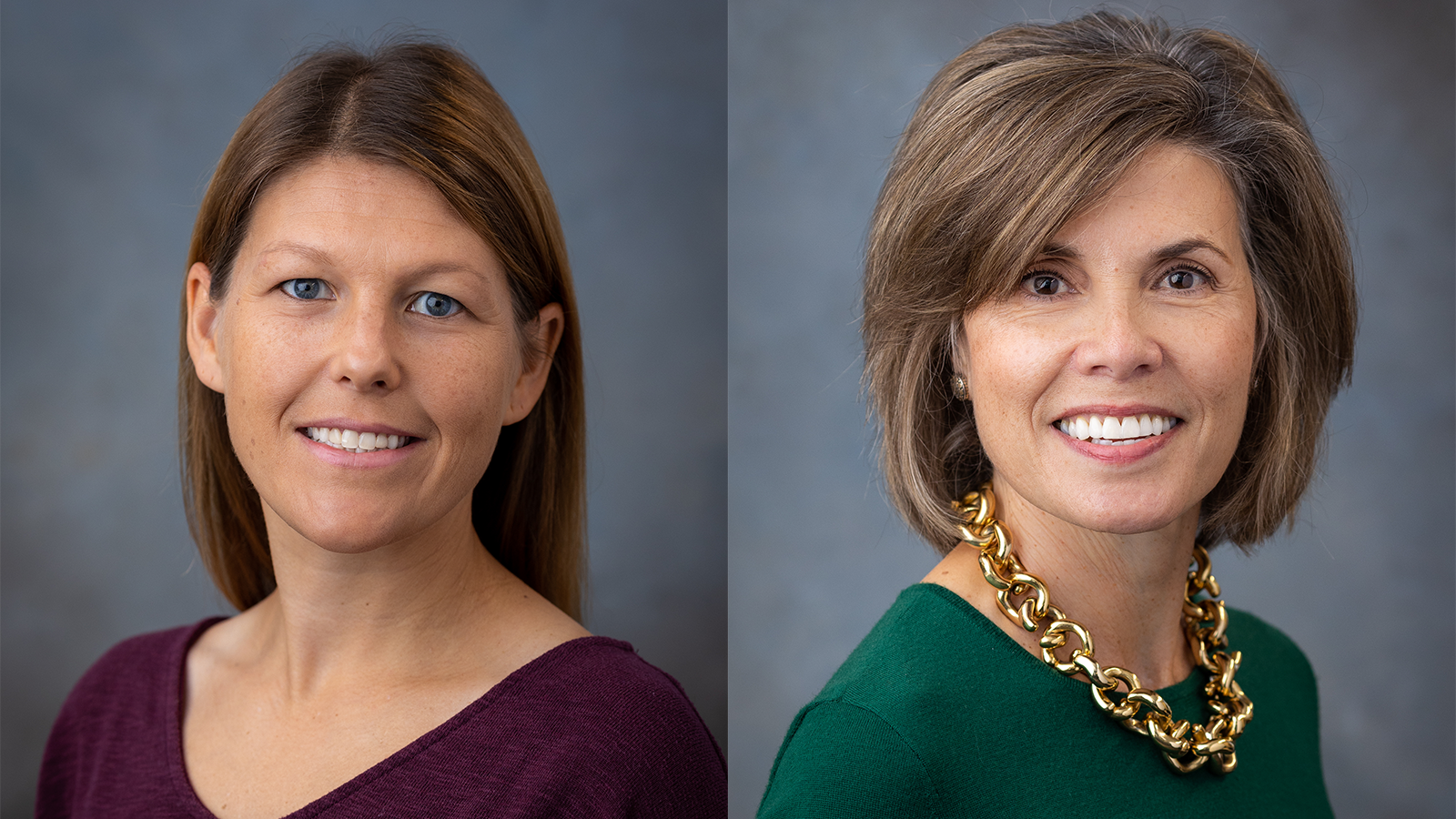
Baylor University's Robbins College of Health and Human Sciences is pleased to announce the appointment of two new program directors for the Doctor of Occupational Therapy (OTD) programs. Kayla Collins, EdD, MOT, OTR, Clinical Associate Professor, has been named Program Director for the Entry-level OTD program, and Barbara Doucet, PhD, OTR, Clinical Associate Professor, and Director of Faculty Development & Scholarship, has been named Program Director for the Post-professional OTD program.
Both Collins and Doucet have both been integral to the Department since its beginning in 2020. In this Q&A, discover their bold visions for the future as they lead the continued growth of Baylor’s dynamic occupational therapy education programs.
Kayla Collins, EdD, MOT, OTR, Clinical Associate Professor, Entry-level OTD Program Director
What are some of the experiences and skills that prepared you to take on this new leadership position?
My experiences have uniquely prepared me for this leadership role. As Director of Student Affairs during the launch of the OTD program, I collaborated with students and faculty to establish advising guidelines and organize key student-centered events such as orientation and graduation.
As Director of Curriculum, I led accreditation processes and spearheaded initiatives for continuous quality improvement in curriculum design and delivery. Then, as Director of the Post-professional OTD program, I revitalized the curriculum, shifting to a 16-month cohort-based model and welcoming our largest class to date. I also led the development and implementation of the Certificate in Hybrid Teaching for the Occupational Therapy Practitioner. Each of these roles has refined my leadership abilities and equipped me to effectively serve as Program Director for the Entry-level OTD program.
What is your vision for Baylor's Entry-level OTD program?
My vision for Baylor's Entry-level OTD program is to establish it as a leader in Christian hybrid education for future generations of occupational therapy practitioners. The foundation of a strong program lies in a curriculum grounded in evidence and delivered by scholars who are both exceptional practitioners and skilled educators. Equally important is fostering a strong sense of community and connectedness among students, which is essential for meaningful learning.
I approach hybrid education through the lens of the community of inquiry theory, emphasizing the importance of teaching presence, social presence, and cognitive presence as essential aspects of teaching and learning. At Baylor, we excel in these areas, and I am committed to ensuring the program remains rigorous, relevant, and supportive of our students. Through this vision, we aim to build a foundation rooted in service, equity, and belonging, creating a nationwide community of Christian scholars dedicated to excellence and a positive impact in occupational therapy.
There are several new occupational therapy programs emerging across the country. How do you leverage Baylor's position as a pioneering hybrid OTD program while ensuring it remains innovative and maintains a leading edge?
Our established track record—including high graduation rates, strong National Board for Certification in Occupational Therapy (NBCOT) exam pass rates, and compelling alumni testimonials—demonstrates that our program is trustworthy, student-centered, and academically rigorous. This reputation positions us as a leader in hybrid education allowing us to leverage our strengths while focusing on innovation to remain ahead of the curve.
Baylor’s program is distinguished by our faculty, who are not only expert clinicians, but also actively engaged in professional service, research, and teaching. Their active involvement in the profession ensures they bring the latest techniques, evidence-based practices, and emerging trends directly into the curriculum. Additionally, we capitalize on Baylor’s robust teaching and learning resources, including cutting-edge technology that supports innovation in hybrid education.
Our faculty are specifically trained in hybrid teaching and leverage these skills creatively to deliver an exceptional educational experience through methods like simulation, telehealth training, and advanced clinical reasoning strategies. These approaches ensure our students graduate fully prepared to lead and adapt to the future demands of occupational therapy practice. By building on our established foundation while embracing continuous improvement and innovation, we aim to remain at the forefront and solidify Baylor’s position as the leader in hybrid OTD education.
What do you enjoy most about this leadership opportunity?
What I enjoy most about this leadership opportunity is witnessing the growth and success of our students, faculty, and alumni. Seeing our alumni thrive as occupational therapists and make a tangible difference in the lives of those they serve is deeply rewarding. I also love watching our faculty embrace their roles as educators at a Christian university, where they can integrate their faith into teaching—something many of us couldn’t do at previous institutions. This blend of faith, passion for occupational therapy, and commitment to education beautifully reflects Baylor’s mission.
Additionally, I cherish the "light-bulb moments" with our students—whether in the lab or during online synchronous sessions—when concepts click, and you can feel their excitement and relief. Watching their journey to becoming occupational therapists, especially their enthusiasm and determination through challenges, reminds me of why I became an educator. These transformative moments make this role truly special.
What kind of impact do you hope to have on Baylor Occupational Therapy through your role?
Through my role, I hope to inspire a deep love and passion for occupational therapy in the students we teach, equipping them to make a meaningful difference in their communities. I also aim to mentor new faculty to become exceptional educators who deliver rigorous, student-centered, and innovative education.
I hope to expand the reach of Baylor’s mission across the country by continuing to attract students from diverse regions, including underserved areas, while enabling them to remain rooted in their communities to serve populations that may otherwise lack access to occupational therapy services. Ultimately, I aspire to see Baylor Occupational Therapy recognized as one of the top programs in the nation, known for excellence in education, innovation, and its profound impact on the profession.
Barbara Doucet, PhD, OTR, Clinical Associate Professor, Director of Faculty Development & Scholarship, Post-professional OTD Program Director
What are some of the experiences and skills that prepared you to take on this new leadership position?
I have been fortunate to hold leadership positions here at Baylor, including Director of Doctoral Capstone and Scholarship, as well as Chair of the Faculty Development Committee. In addition, I have extensive leadership experience from my previous roles, such as President, Vice-President, and Education Chair of the Louisiana Occupational Therapy Association.
What is your vision for Baylor's Post-professional OTD program?
My vision for Baylor’s Post-professional OTD program is to foster enthusiasm among practitioners and support lifelong learning. As our profession continues to change and evolve, it is critical that practicing clinicians stay informed and maintain a deep understanding of best practices. In the short-term, I envision the Baylor Post-professional OTD program attracting a growing number of motivated practitioners each year—those who are eager to advance their clinical expertise, enhance their teaching skills, or both. In the long-term, I hope to cultivate a thriving community of Baylor Post-professional OTD graduates who share their positive experiences, thereby encouraging others to pursue advanced education and ultimately expanding the number of advanced practitioners within our profession.
How does the Post-professional OTD program continue to leverage Baylor's specialization in hybrid teaching? Why is there a need for this specific education/preparation?
I am so excited about our newest initiative, the Certificate in Hybrid Teaching for the Occupational Therapy Practitioner, developed by Dr. Collins. Baylor is uniquely positioned to lead in this area, thanks to our highly qualified faculty, many of whom hold a Doctor of Education (EdD) and specialize in online learning and hybrid teaching. Our faculty’s expertise in pedagogy and educational technology further strengthens our ability to offer specialized training that is truly unmatched in occupational therapy education.
As our profession grows, many practitioners find themselves wanting to share their knowledge and help shape the future of the profession by teaching the next generation of occupational therapists. With educational programs increasingly transitioning to fully or partially online curricula, Baylor stands at the forefront of preparing educators to excel in this mode of delivery—ensuring they are equipped to provide effective, meaningful learning experiences in a hybrid format.
What do you enjoy most about this leadership opportunity?
I am incredibly stimulated by our learners. These clinicians enter our program with a diverse range of life experiences and professional expertise. I learn so much from each student I have instructed! Moreover, I so enjoy and feel extremely fortunate to be able to role model and share my Christian faith openly with them and impart the importance of servant leadership, compassion, and kindness—this is so important as we are in a serving profession!
What kind of impact do you hope to have on Baylor Occupational Therapy through your role?
I am excited about Baylor's new strategic plan, Baylor in Deeds, and look forward to expanding our offerings in alignment with its key imperatives. Specifically, I aim to develop our expertise at the intersection of technology and human life, contributing to solutions for global challenges like healthcare disparities and technological innovation. I also want to ensure that our programs embody the values of the plan’s Affordability, Value, and Completion imperative—making advanced education accessible and affordable while upholding excellence. Finally, I am committed to fostering a culture of civil discourse, where respectful and constructive dialogue thrives among individuals from diverse backgrounds.